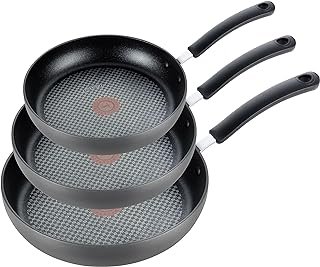
A frying pan set gives you matched pans in multiple sizes, covering the range of everyday stovetop cooking tasks. Understanding what to look for in a set helps you avoid buying mismatched pans that perform differently and wear at different rates.
Why Buy a Set
A matched set of frying pans ensures consistent material, coating, and construction across all sizes. This means predictable performance across different tasks — the way your 8-inch pan behaves tells you how the 12-inch will behave. Sets are also usually more economical than purchasing pans individually.
Common Set Compositions
A typical two or three-piece frying pan set includes an 8-inch pan (for eggs, small amounts of vegetables, and single-serving preparations), a 10-inch pan (the most versatile general-purpose size for most stovetop tasks), and sometimes a 12-inch pan (for larger quantities, steaks, and family-sized portions).
Materials
Nonstick-Coated Aluminum
The most popular material for frying pan sets. Nonstick surfaces are ideal for eggs, fish, and delicate proteins that would stick and tear on stainless. Modern nonstick coatings (PFOA-free PTFE) are durable under normal use conditions (medium heat, non-metal utensils). Aluminum heats quickly and evenly. The main limitation is heat — nonstick coatings degrade at very high temperatures, so they should not be used for searing tasks that require maximum heat.
Stainless Steel
Stainless steel frying pan sets are more durable than nonstick and can handle high-heat searing. However, food sticks more easily until the pan is properly preheated and oiled. Stainless pans require more cooking technique — the cold pan test and water droplet test help confirm the right temperature before adding food. The cooking surface improves with use.
Cast Iron
Cast iron frying pans are sold individually rather than in sets, typically. They are extremely durable, develop a natural nonstick patina with seasoning, and handle high heat for searing. They are heavy and take longer to heat but retain heat excellently.
Gauge and Construction
Heavier gauge pans maintain heat better when food is added and produce more even browning. Thin, lightweight pans develop hot spots and their temperature drops significantly when food is added. For nonstick sets, look for pans with a heavy gauge base — typically described as hard-anodized or with a reinforced base.
Handle Design
Handles should be long enough to keep your hand away from the heat source, comfortable to grip, and securely riveted to the pan. Stay-cool handles are useful. Oven-safe handles allow pans to transition from stovetop to oven — look for the temperature rating.
What to Look For
For everyday cooking including eggs, fish, vegetables, and general sauting, a nonstick-coated hard-anodized aluminum set covering 8, 10, and 12 inches is the most practical choice for most home kitchens. The T-fal and Cuisinart Advantage lines offer strong value. For serious searing and high-heat cooking, a stainless or cast iron set is more appropriate.
Summary
A frying pan set provides matched performance across multiple sizes. Material, gauge, handle design, and coating quality are the key factors. A well-chosen set in the right material for your cooking style covers most daily stovetop tasks reliably.
You can check more details and current options on Amazon here.