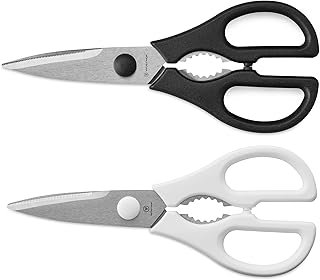
Kitchen shears are a versatile cutting tool that belongs in every kitchen. They handle tasks that knives handle poorly or that require two hands that a knife cannot safely accommodate. Understanding the features that separate good shears from poor ones helps you choose wisely.
What Kitchen Shears Are For
Kitchen shears perform tasks including: cutting pizza, flatbreads, and quesadillas into portions; snipping fresh herbs directly into a dish; breaking down whole poultry (spatchcocking) by cutting along both sides of the backbone; trimming the fins from fish; cutting bacon strips into pieces; opening packaging; trimming the sinew from meats; cutting dried pasta or noodles; snipping canned tomatoes in the can.
Come-Apart Design
The most important feature to look for is a come-apart design — blades that can be separated from each other for thorough cleaning. Kitchen shears cut raw poultry, meat, and fish. Without the ability to separate the blades, the pivot area accumulates food residue that is impossible to clean adequately, creating a hygiene issue. The Wusthof and J.A. Henckels come-apart shears are consistently recommended for this reason.
Blade Material and Sharpness
Stainless steel blades are the standard. High-carbon stainless holds a sharper edge and cuts more cleanly than basic stainless. The blades should feel sharp from the start and should be able to be sharpened or replaced when they dull. Some inexpensive kitchen shears cannot be sharpened and must be replaced when dull.
Micro-Serration
Many kitchen shears feature one slightly serrated blade. The serration grips food (particularly slippery skin or fat) and prevents it from sliding forward as you cut. This is useful for cutting through chicken skin or smoked salmon. A fully straight-edged set slips more on these materials.
Additional Features
The pivot area of quality kitchen shears often includes additional tools: a bottle opener, jar-lid gripper, bone notch (for cracking small bones or lobster shells), and a nutcracker. These add-ons are not critical but can be convenient if you use them regularly.
Handle Comfort
Kitchen shears should be comfortable for both right-handed and left-handed users. Ambidextrous or symmetrical handle designs accommodate both. Spring-loaded designs that open automatically after each cut are helpful for continuous cutting tasks and reduce hand fatigue.
Cleaning
Come-apart shears can be washed in the dishwasher once separated. Fixed-blade shears should be hand washed and immediately dried to prevent rust at the pivot. After washing, the pivot area should be oiled lightly with food-safe mineral oil if the shears feel stiff.
What to Look For
For most home kitchens, a come-apart design in high-carbon stainless steel, with a micro-serrated blade for grip and a comfortable handle is the ideal specification. Wusthof, J.A. Henckels, and Messermeister make well-regarded kitchen shears in this category.
Summary
Kitchen shears are an underappreciated tool that handles a wide range of kitchen tasks more efficiently than a knife. A come-apart design for proper cleaning is the single most important feature to prioritize.
You can check more details and current options on Amazon here.